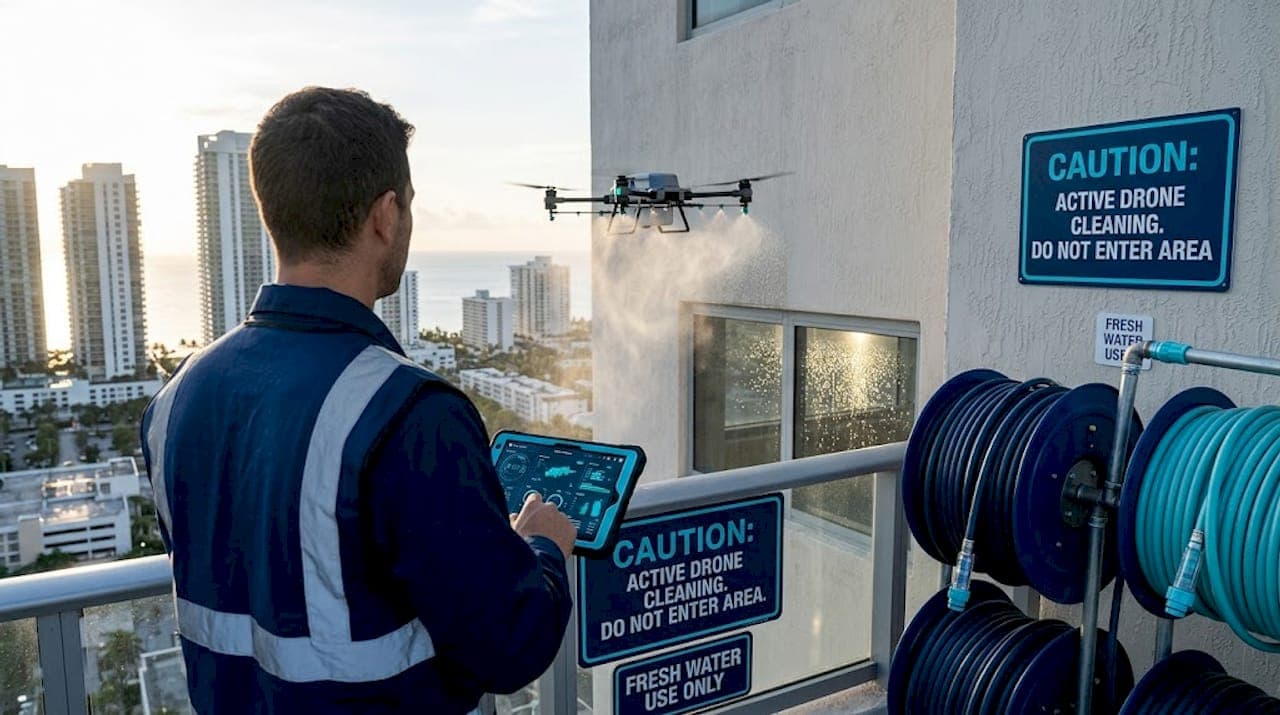
Most commercial property managers in South Florida assume pressure washing is the go-to solution for keeping a high-rise exterior clean. It's familiar, it's widely available, and it looks powerful. But that assumption is costing buildings more than it should, in surface damage, liability exposure, and unnecessary downtime. Soft washing is a fundamentally different approach that protects your building's exterior while delivering results that last longer, cost less over time, and eliminate many of the risks that come with traditional high-pressure methods.
Table of Contents
- What is soft washing for building exteriors?
- Key benefits of soft wash for commercial high-rises
- Soft washing vs. pressure washing: When to use each
- Soft washing for high-rise exteriors: Techniques and best practices
- Why going soft is the smartest move for South Florida high-rises
- Protect your building with innovative soft washing solutions
- Frequently asked questions
Key Takeaways
| Point | Details |
|---|---|
| Gentle and effective | Soft washing uses low pressure and special detergents to safely clean building exteriors. |
| Ideal for high-rises | It preserves façade integrity and reduces risk on tall commercial buildings compared to old methods. |
| Cost and time savings | Drone soft washing reduces labor, setup, and disruption for busy properties. |
| Better for the environment | Soft wash solutions are often biodegradable and minimize harmful runoff. |
What is soft washing for building exteriors?
Soft washing is a low-pressure exterior cleaning method that relies on biodegradable cleaning solutions rather than brute water force to remove dirt, biological growth, and staining from building surfaces. Where pressure washing blasts contaminants off a surface using water at 1,500 to 4,000 PSI or more, soft washing applies water at 60 to 500 PSI, roughly equivalent to a garden hose. The real cleaning power comes from the chemistry, not the pressure.
The cleaning solutions used in professional soft washing typically include surfactants (which loosen and lift grime), sodium hypochlorite at diluted concentrations (to kill mold, algae, and mildew at the root), and neutralizers to protect landscaping and surrounding surfaces. Because the contaminants are chemically broken down before being rinsed away, results last significantly longer than pressure washing alone.
Here's what distinguishes soft washing from conventional methods:
- Low-pressure application protects delicate surfaces like stucco, painted concrete, EIFS (exterior insulation and finish systems), and glass seals
- Biodegradable solutions break down biological growth at the root level, not just the surface
- Longer-lasting results because the source of contamination is treated, not just visually removed
- No risk of surface erosion from high-pressure water cutting into mortar, caulking, or coatings
- Safer for workers and surrounding areas since there's no high-pressure spray to manage at elevation
"Soft washing is the preferred method for maintaining the appearance and integrity of commercial building exteriors because it cleans without compromising the surface materials that protect the structure itself." The soft washing benefits for high-rise buildings go well beyond aesthetics.
This distinction matters enormously for high-rises. A 30-story building in Miami isn't just a surface cleaning challenge. It's a complex exterior system with multiple materials, sealed joints, window gaskets, and coatings that can all be damaged by excessive pressure. Soft washing respects that complexity.
Key benefits of soft wash for commercial high-rises
Understanding how soft washing works, let's look at the specific reasons so many commercial property managers are making the switch.
The most immediate benefit is surface preservation. High-rise exteriors in South Florida are typically finished with stucco, painted concrete, aluminum cladding, or glass curtain wall systems. These materials are engineered to protect the building's structure, but they're not indestructible. Repeated high-pressure washing strips paint, erodes mortar joints, and degrades the sealants around windows and expansion joints. Once those sealants fail, water intrusion becomes a real and expensive problem. Soft washing eliminates that risk entirely.
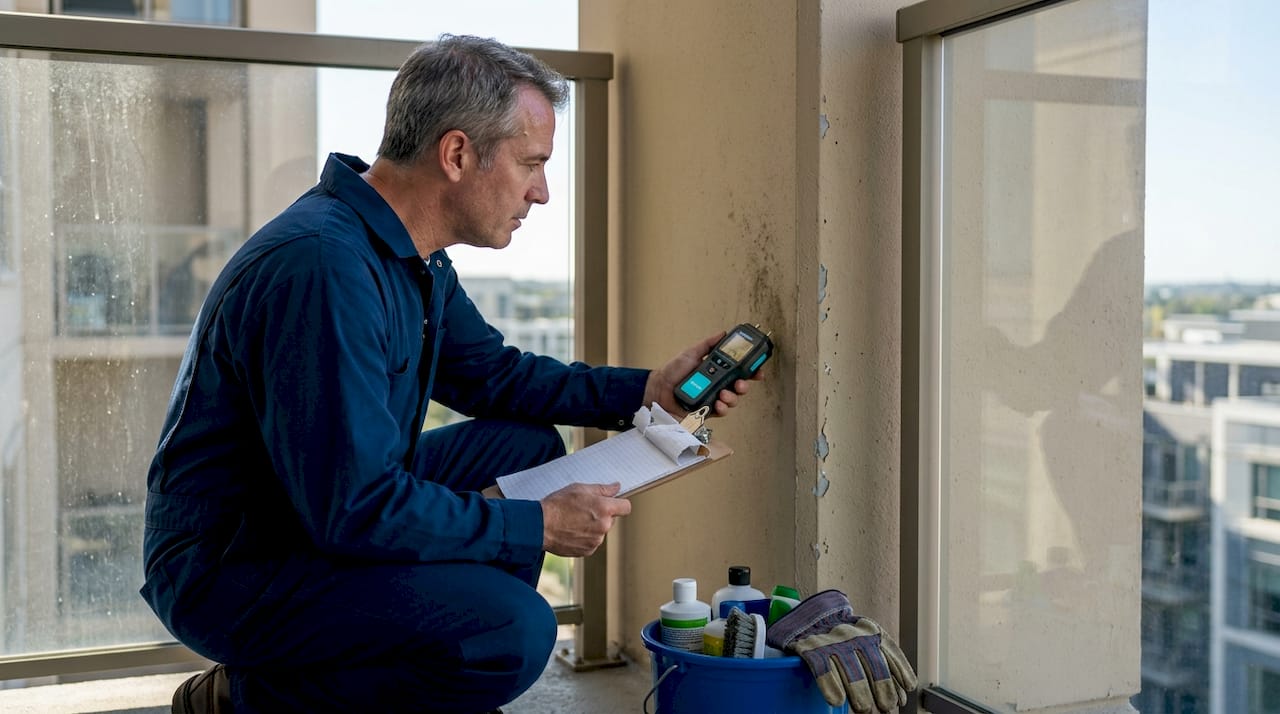
Biological growth removal is another critical advantage. South Florida's heat and humidity create ideal conditions for algae, mold, mildew, and lichen to colonize building exteriors. These aren't just cosmetic issues. Algae and mold retain moisture against the building surface, accelerating material degradation and, in some cases, creating health concerns for occupants. Soft washing kills these organisms at the root, meaning regrowth takes significantly longer than after a pressure wash that only removes surface-level contamination.
From a cost management perspective, the numbers are compelling. Commercial building cleaning using drone-delivered soft wash can reduce project costs by 30 to 60 percent compared to traditional scaffolding-based methods. That's not just the cleaning cost. It includes the elimination of scaffold rental, traffic management permits, extended project timelines, and the liability costs associated with workers operating at height.
Key benefits at a glance:
- Extends the service life of exterior coatings, sealants, and cladding systems
- Reduces water intrusion risk by preserving joint and gasket integrity
- Kills biological growth at the root for results that last 2 to 3 times longer
- Minimizes tenant disruption since there's no scaffolding blocking windows or access points
- Lowers overall maintenance costs across the building's lifecycle
Pro Tip: When evaluating soft washing providers for a high-rise, ask specifically about their application method at elevation. Drone façade soft washing eliminates the need for scaffolding or rope access entirely, reducing both project timelines and liability exposure for your property.
The tenant experience factor is often underestimated. Scaffolding on a residential tower or hotel can block natural light, create noise, and restrict access to balconies and amenities for days or weeks. Drone-based soft washing completes most high-rise projects in a single day without any of those disruptions.
Soft washing vs. pressure washing: When to use each
But how does soft washing stack up against the familiar method of pressure washing? Let's break it down.
The honest answer is that both methods have their place, but for high-rise commercial buildings, soft washing wins in almost every category that matters to property managers. The table below captures the key differences:
| Factor | Soft washing | Pressure washing |
|---|---|---|
| Water pressure | 60 to 500 PSI | 1,500 to 4,000+ PSI |
| Surface compatibility | Stucco, EIFS, glass, painted concrete, cladding | Concrete, brick, pavers, bare masonry |
| Cleaning mechanism | Chemical treatment plus rinse | Mechanical force |
| Risk of surface damage | Very low | Moderate to high on delicate surfaces |
| Biological growth removal | Kills at the root | Removes surface layer only |
| Result longevity | 2 to 3 years typical | 6 to 12 months typical |
| Worker safety at height | High risk with traditional equipment | High risk with traditional equipment |
| Drone delivery option | Yes, fully compatible | Limited compatibility |
| Water consumption | Lower overall | Higher overall |
| Disruption to tenants | Minimal with drone method | Significant with scaffolding |
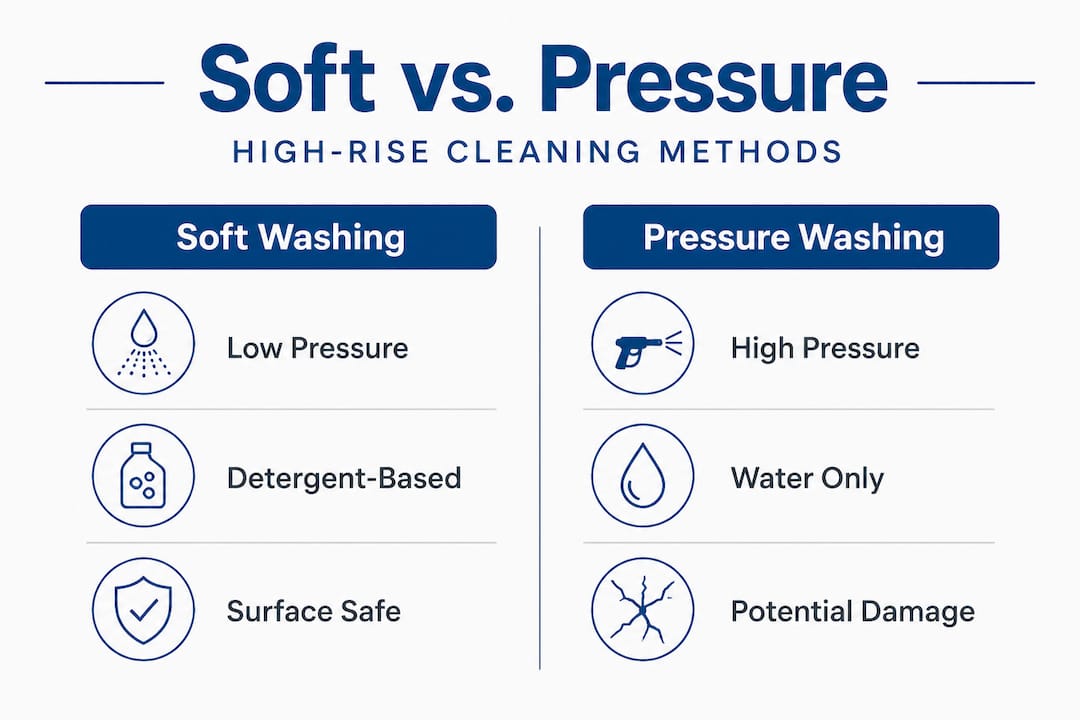
The soft wash vs pressure cleaning comparison makes it clear that surface type is the primary deciding factor. Pressure washing is appropriate for ground-level hardscape like parking garages, concrete walkways, and loading docks where surface erosion isn't a concern. For anything above the first or second floor on a commercial building, especially surfaces with coatings, sealants, or decorative finishes, soft washing is the safer and more effective choice.
Surfaces best suited to soft washing on a high-rise:
- Painted or coated concrete facades
- Stucco and EIFS systems
- Glass curtain walls and window frames
- Aluminum and composite cladding panels
- Roof membranes and parapet walls
- Balcony railings and undersides
Surfaces where pressure washing may still be appropriate:
- Exposed concrete at grade level
- Uncoated masonry at ground level
- Parking structures with no applied finishes
Pro Tip: Never let a contractor use high-pressure equipment on EIFS or stucco above the second floor. Even a single pass at the wrong angle or pressure can create micro-cracks that allow water infiltration, leading to costly repairs that far exceed the cleaning budget.
Soft washing for high-rise exteriors: Techniques and best practices
If you're considering soft washing for your property, here's how a professional high-rise soft wash actually works.
The process is more structured than most property managers expect, and that structure is what separates a quality result from a mediocre one. Here's a typical workflow for a drone-based high-rise soft wash:
- Site assessment and planning. The crew evaluates the building's exterior materials, identifies areas of heavy biological growth or staining, and maps the drone flight path. Wind conditions, nearby air traffic, and building geometry all factor into the pre-job plan.
- Solution preparation. Cleaning solutions are mixed on-site to the appropriate concentration for the specific contaminants and surface materials present. Over-concentration can damage surfaces or harm landscaping; under-concentration won't deliver lasting results.
- Perimeter protection. Ground-level landscaping, vehicles, and pedestrian areas are protected or cordoned off. Drain covers may be temporarily sealed to prevent cleaning solution runoff from entering storm drains, depending on local environmental regulations.
- Drone application. FAA-certified pilots deploy industrial drones equipped with soft-wash delivery systems to apply the cleaning solution evenly across the facade, starting from the top of the building and working downward. This prevents re-contamination of already-cleaned sections.
- Dwell time. The cleaning solution is allowed to dwell on the surface for a specified period, typically 5 to 15 minutes depending on contamination level, to break down biological growth and loosen embedded grime.
- Low-pressure rinse. The drone returns to rinse each section with de-ionized water, removing the cleaning solution and loosened contaminants without damaging the surface.
- Quality inspection and documentation. Before-and-after photos and video are captured from the drone, giving you a documented record of the work completed and the condition of the building exterior.
The drone cleaning best practices for high-rises emphasize working top-to-bottom and using de-ionized water for the final rinse to prevent mineral spotting on glass and polished surfaces.
Here's a reference table for planning your building's maintenance schedule and budget:
| Building height | Recommended frequency | Typical project duration | Estimated cost range |
|---|---|---|---|
| Up to 10 floors | Every 12 months | Half day to full day | $2,000 to $6,000 |
| 11 to 20 floors | Every 12 to 18 months | 1 day | $5,000 to $12,000 |
| 21 to 40 floors | Every 12 to 18 months | 1 to 2 days | $10,000 to $25,000 |
| 40+ floors | Every 12 months in coastal areas | 2 to 3 days | $20,000 to $50,000+ |
Use the calculating cleaning costs tool to get a more precise estimate based on your building's specific dimensions and surface types.
Pro Tip: Always confirm that your soft washing provider uses FAA-certified drone pilots and carries both general liability insurance and drone-specific aviation liability coverage. This protects your property from any incident during the project and keeps you compliant with local airspace regulations in Miami-Dade and Broward counties.
Why going soft is the smartest move for South Florida high-rises
Here's a perspective that most cleaning industry conversations avoid: the South Florida environment doesn't just make buildings dirty faster, it actively accelerates structural degradation in ways that most property managers don't fully account for until they're looking at a repair bill.
Salt air from Biscayne Bay and the Atlantic doesn't just leave a hazy film on glass. It penetrates micro-cracks in stucco and coatings, corrodes metal fasteners behind cladding panels, and accelerates the breakdown of sealants around windows and expansion joints. Combine that with 60 to 70 inches of annual rainfall, average humidity above 75 percent, and intense UV exposure, and you have an environment that is genuinely hostile to building exteriors. A building in Miami ages faster than a comparable building in Denver or Chicago, full stop.
This is why the "clean it when it looks dirty" approach is a false economy. By the time visible staining and biological growth appear on a high-rise facade, the underlying surface has already been under biological attack for months. Algae and mold root systems penetrate coatings and sealants before they're visible to the naked eye. Regular soft washing on a scheduled maintenance cycle treats the problem before it becomes structural, not after.
The shift to drone-based soft washing isn't just a technology upgrade. It's a fundamental change in how we think about the risk profile of building maintenance. Traditional scaffolding-based cleaning puts workers at serious height-related risk, creates weeks of tenant disruption, and introduces significant liability for property owners. The no-scaffolding cleaning model removes all of that from the equation. No workers suspended above traffic. No scaffolding blocking storefronts or amenity decks. No extended project timelines eating into your operating budget.
Forward-thinking property managers in Miami are already treating drone soft washing as a standard line item in their annual maintenance budgets, not an experimental technology. The ROI is clear, the safety record is strong, and the results speak for themselves on buildings from Brickell to Edgewater to Aventura.
Protect your building with innovative soft washing solutions
South Florida's commercial buildings face a uniquely demanding environment, and they deserve a cleaning approach that matches that challenge with precision, safety, and efficiency.
At Exterior Drone Washing, we specialize in commercial building cleaning for high-rises, condos, hotels, and office towers throughout South Florida using FAA-certified industrial drones and professional soft-wash systems. Whether you manage a Brickell building cleaning project or a waterfront tower in Edgewater, we deliver thorough, documented results without scaffolding, without disrupting your tenants, and without the liability exposure of traditional methods. Our drone cleaning services are designed specifically for the commercial property management market. Contact us today for a consultation and project quote tailored to your building's specific needs.
Frequently asked questions
Is soft washing safe for all building materials?
Soft washing is safe for most modern exterior materials, including stucco, stone, and painted surfaces, due to its low-pressure approach and gentle cleaning agents. For specialty materials, a professional assessment confirms the right solution concentration before any work begins, as outlined in commercial facade care.
How often should my building exterior be soft washed?
Most South Florida commercial buildings benefit from exterior soft washing every 12 to 18 months, or more frequently in coastal environments with high humidity, salt air, and heavy biological growth.
Does soft washing help with mold and algae?
Yes, soft washing removes and prevents mold, algae, and mildew stains that are common on South Florida high-rises by killing the organisms at the root rather than just removing surface-level growth, giving results that last significantly longer according to commercial facade specialists.
Will soft washing disrupt tenants or require scaffolding?
Drone-enabled soft washing drastically reduces disruptions and eliminates the need for scaffolding on most buildings, with most high-rise projects completed in a single day according to exterior drone washing project data from South Florida properties.